Who, What, Wear-able Tech: Public Employers Should Consider Adopting New Policies to Protect Employees from Wearable Technology
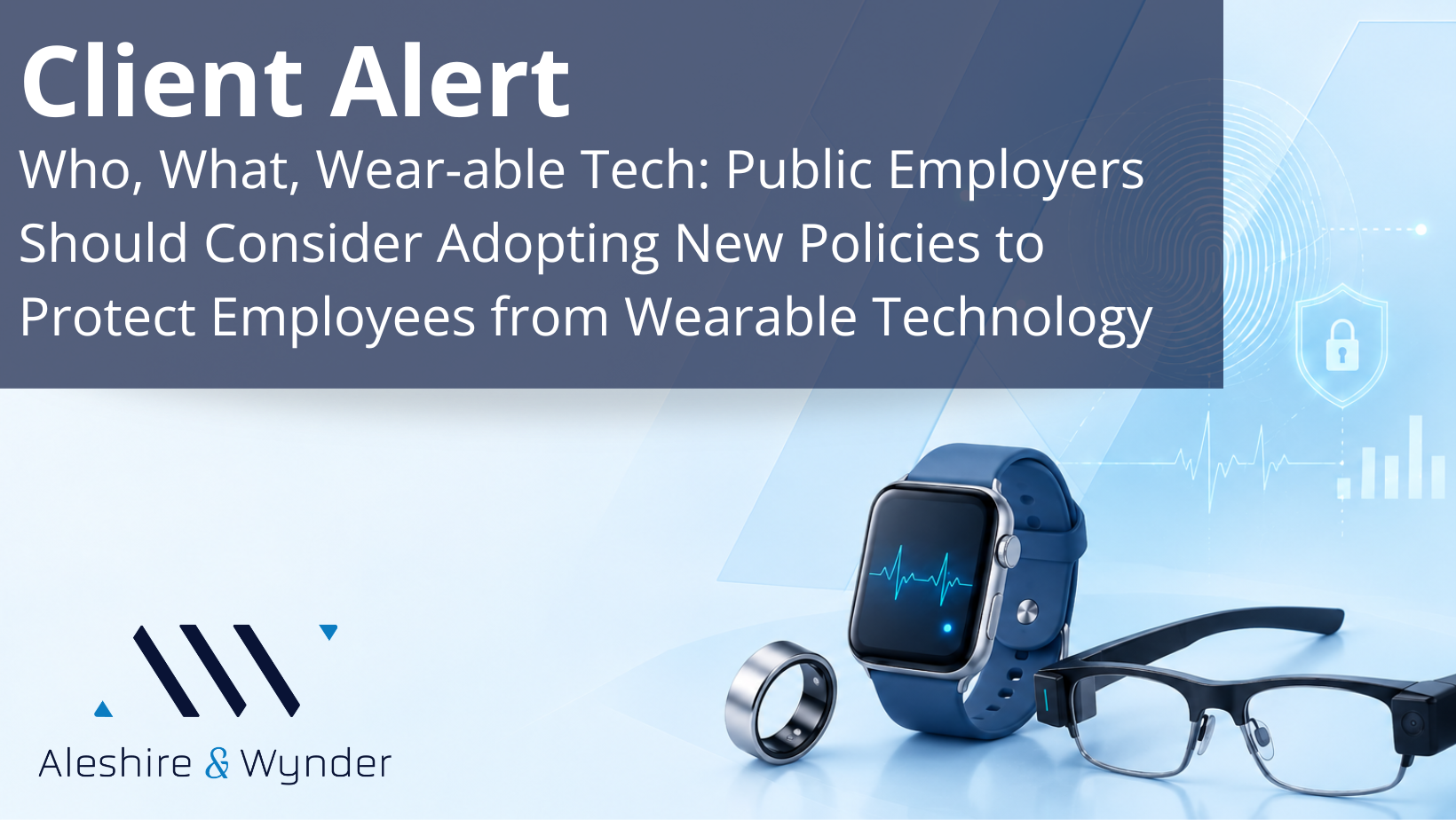
Employers must be cautious when providing, or allowing the usage of, wearable technology to its employees. This is because wearable technology may inadvertently violate employment discrimination laws through its ability to track various personal physical factors. Given the advancements in wearable technology, employers should also be prepared to revise their dress code and/or personnel rules to reflect how wearable technology should be used in the workplace in order to protect those whose conduct could be recorded by those utilizing this technology.
Why it matters
Under existing 42 U.S.C.A. Section 12112 (d)(4)(a), employers cannot require a medical examination or make inquiries as to whether their employee has a disability, or the nature and severity of their disability, unless it is job-related and consistent with business necessity. On December 19, 2024, the U.S. Equal Employment Opportunity Commission (EEOC) sent out a news release highlighting how employer-mandated wearable technology, such as watches, rings, glasses, or helmets, may implicate employment discrimination laws by inadvertently conducting a “medical examination” when it collects information about worker health and biometric data.[1] Further, if the wearable technology requires employees to disclose their health information, that requirement could be construed as the employer making a “disability-related inquiry.”[2] This accumulation of information from the wearable technology could cause an employer to violate 42 U.S.C.A. Section 12112 (d)(4)(a). The EEOC further cautions employers that a violation of anti-discrimination laws would occur if the data collected about employees’ sex, age, genetic information, disability, or race is used to take an adverse action against an employee.[3]
Wearable technology also requires a balancing test of employees’ rights. It remains true that “[a]ll people are by nature free and independent and have inalienable rights. Among these rights are enjoying and defending life and liberty, acquiring, possessing, and protecting property, and pursuing and obtaining safety, happiness, and privacy.”[4] However, there are concerns that wearable technology may be violating other employees’ right to privacy. These devices could be recording areas where employees and members of the public have a reasonable expectation of privacy.[5] Employees using wearable tech may inadvertently capture another employee taking their prescriptions or a physical break, or looking at their medical documents, which could potentially expose that employee’s physical or physiological ability to perform tasks.[6]
Additionally, employees using wearable technology could record activities occurring in a normally private space, such as a restroom or locker room, without the knowledge of their co-workers and in violation of employees’ privacy rights and expectations.[7] This may also violate California Penal Code Section 632, which prohibits the use of a recording device to eavesdrop upon or record confidential communications intentionally and without the consent of all parties to a confidential communication, with limited exceptions. Just as concerning, this data may be subject to disclosure under the California Public Records Act, which may further implicate privacy issues and expand the need to monitor data that could be considered public record.[8]
Key Takeaways for Public Employers:
In reviewing personnel rules or dress code policies pursuant to wearable technology, employers should consider:
- Limitations: Limit the use of devices with a recording capability when in private settings.
- Review Reasonable Accommodations: Assess if the need for wearable technology is pursuant to an employee’s reasonable accommodation.
- Notifications: Notify public employees that their wearable technology devices that record surroundings could be subject to California Public Records Act.
- Assessment: If employers are providing wearable technology, they should assess whether the technology is requiring or collecting information that could be considered a “medical examination” or “disability-related inquiry.”
* Specific loan program availability and requirements may vary. Please get in touch with your mortgage advisor for more information.