Legal Update: United States v. Pereda (9th Cir. 2026)
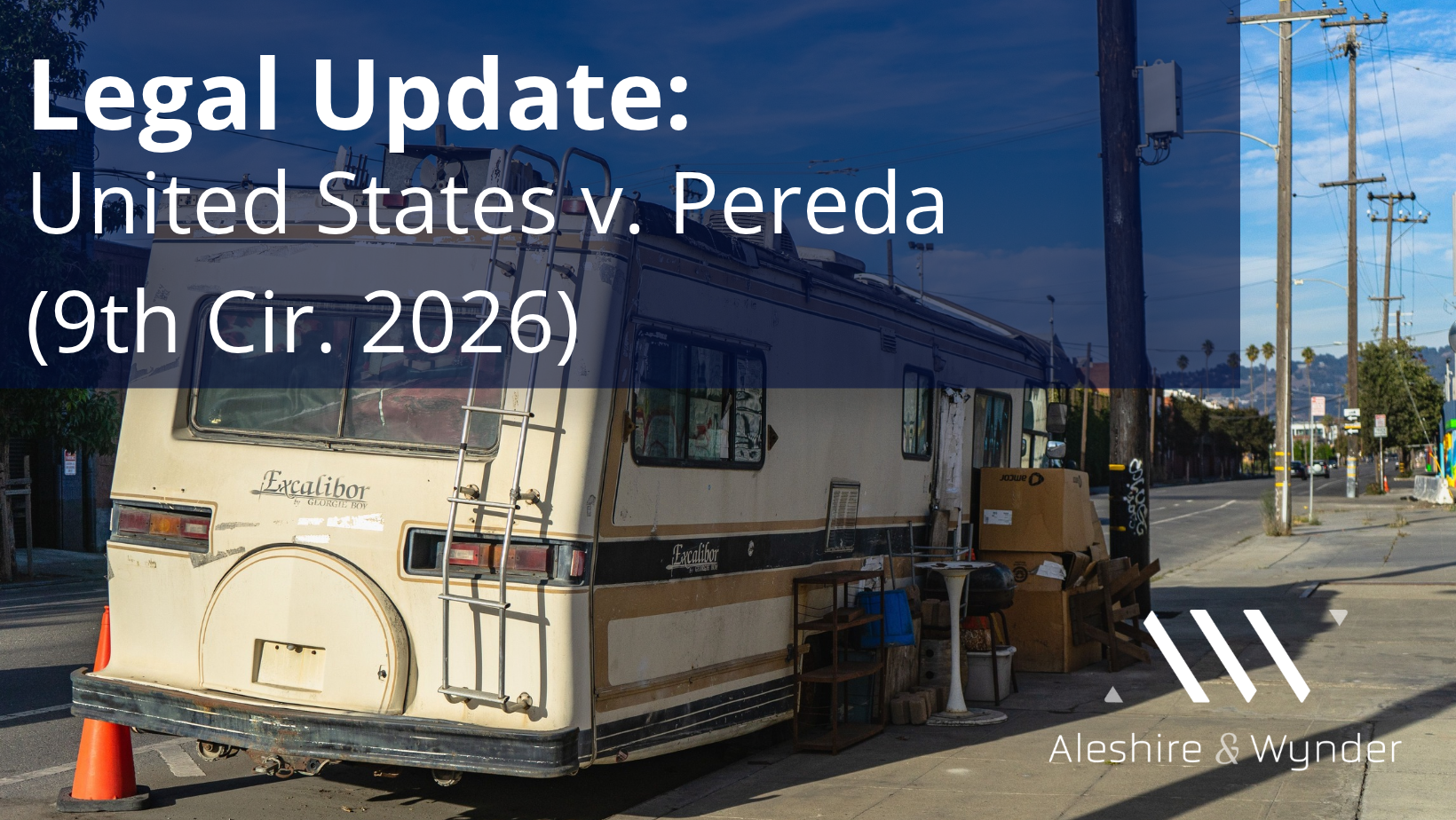
A supervision search of an unreported residence or vehicle is valid when the facts known before the search, taken together, give probable cause that the supervisee lives there or owns or controls it. In Pereda, the Ninth Circuit reversed a suppression order, 2-1, upholding searches of a trailer and a pickup. The case was won on the detective's prior surveillance and the probation officer's GPS work.
FACTS
- Pereda was on post-release community supervision (“PRCS”) after early release from a state prison term for violent felonies. His search terms allowed warrantless searches of him, his "residence," and "any other property under [his] control."
- He reported his parents' home in Lompoc as his residence. GPS showed him consistently staying at his girlfriend's parents' home in Goleta, including overnight, from March to June 2024. His prior probation officer had done home visits there. The location was known to his probation officers for some time.
- At the Goleta house, the girlfriend's mother told officers he was "in the trailer." The trailer sat about 15 feet from the house and was positioned on poles and cinderblocks and was not capable of being moved in that condition. There was an extension cord running out to the trailer for electrical power.
- When the officers knocked on the trailer door, the girlfriend said through the door that he was not there. However, officers heard a male voice inside, and eventually Pereda came out when ordered.
- A white Ford F-150 was parked next to the trailer. A sheriff's detective had seen Pereda driving a white F-150 about five times in prior weeks and they ran the plate on the truck and it came back registered to him.
- Officers searched the trailer and located ammunition and glass pipes. When they searched the truck, they found methamphetamine, fentanyl, and heroin.
- In the lower district court, all of the evidence was suppressed. The government appealed.
CASE
|
Case |
United States v. Pereda, No. 25-4461 (9th Cir. July 23, 2026), published |
|
Trial court |
C.D. Cal., Judge Monica Ramirez Almadani (granted suppression) |
|
Panel |
Bumatay (opinion), Callahan; Paez (dissent) |
|
Agencies |
Santa Barbara County Probation; Santa Barbara County Sheriff's Office |
|
Supervision |
Post-release community supervision (PRCS) with GPS and a search condition covering his person, "residence," and "any other property under [his] control" |
|
Evidence |
Ammunition and glass pipes (in a trailer); methamphetamine, fentanyl, heroin (in a parked truck) |
|
Federal charges |
Possession with intent to distribute (21 U.S.C. § 841(a)(1)); felon in possession of ammunition (18 U.S.C. § 922(g)(1)) |
|
Result |
Suppression order reversed (evidence not suppressed) and remanded back to lower court. |
Majority Holdings
- Standard for residence searches. Officers need probable cause that the supervisee lives at the place. It exists if "an officer of reasonable caution would believe, based on the totality of the circumstances," that the supervisee lives there. It is the same probable-cause standard used throughout criminal law; there is no higher tier for supervision searches.
- The trailer was his residence. Together, all of these facts gave a "fair probability" that the trailer was his residence: GPS showing him consistently staying at the Goleta address for about three months, including overnight; a prior probation officer's home visits there; the resident's statement that he was "in the trailer"; the trailer's signs of occupancy; the girlfriend's false denial; and his voice and presence inside.
- No "divide-and-conquer." The district court erred by discounting the GPS data on its own. Facts are weighed as a whole, and an officer need not rule out innocent explanations. It is all of the information considered in its totality.
- The Howard "patterns" are not a checklist. No key, no admission, and no registration check did not defeat probable cause. Those facts help, but they are not required.[i]
- A travel trailer is a vehicle in California. Under Health & Safety Code § 18010(a), a travel trailer is a recreational vehicle even without motive power. So the trailer could also be searched as "property under [his] control." Yet another way of justifying the search.
- The truck was property under his control. For a vehicle, officers need probable cause that the supervisee owns or controls it. The detective's five prior sightings, the earlier plate check showing Pereda as registered owner of a white F-150, the truck parked at the trailer door, and Pereda exiting the trailer met that standard.
- Missing steps are not fatal. The question is whether the facts known at the time created a fair probability that these items fit under the search conditions, and not whether more investigative work would have strengthened the case.
Investigative Lessons
The majority upheld the searches, but the dissent listed the inexpensive steps that would have avoided the fight. Do them.
- Visually confirm the residence before the performing the compliance check. The dissent faulted the lack of in-person surveillance at both the reported (Lompoc) and suspected (Goleta) addresses. Even a few observations of coming and going, parking overnight, or using a key carry weight. Of course, this additional work will be limited by your resources and your case load.
- Treat GPS as one piece of a puzzle, and know about the other pieces in the puzzle and how they fit. The majority relied on months of location history; the dissent stressed that “pings” alone cannot show what the person was doing there.
- Confirm the vehicle on scene. Prior sightings and an earlier registration hit were enough here, but only 2-1. Run the plate or VIN on the day of the search prior to searching it. The dissent noted another similar white pickup was parked on the other side of the trailer.
- Ask the obvious questions. "Who lives here?" "Whose truck is this?" "Who has the keys?" The dissent said any of these might have ended the dispute.
- Note who had the keys. The majority says officers recovered the truck keys from the trailer; the dissent says they came from the girlfriend's purse. Record the exact location and holder.
- Respect third parties. The search reached the girlfriend's belongings. Facts like that fuel suppression arguments and civil claims.
- Consider a warrant when time allows and the residence or ownership facts are thin. A search condition is a tool, not a requirement to skip judicial review.
Reports and Suppression Testimony
The biggest dispute between the majority and the dissent was over what the officers actually knew before the search. Courts judge probable cause only on facts known at that time and not learned after the search.
- What was reviewed matters. On direct examination the probation officer described GPS reports covering at least eight days. On cross, he admitted reviewing only the last two or three days before the check. The district court credited the cross-examination answer.
- After-the-fact exhibits get attacked. The eight-day GPS maps were made about a month before the evidentiary hearing. The dissent said they could not support probable cause because officers did not consult them before the search. The majority relied on the underlying data that was available beforehand.
- Write down each fact and when you learned it. List prior sightings with dates, plate or registration results, GPS ranges actually reviewed, and every on-scene statement and observation.
- Testify to what you did, not what you could have done. Precise, consistent answers on direct and cross keep the factual findings on your side.
Cautions
- 2-1 decision. Judge Paez would have affirmed suppression. He read the facts as showing only that Pereda was an occasional overnight guest, and found at most reasonable suspicion for the truck. Further review is possible.
- Weakest holding. Treating the trailer as "property under control" is contested. The dissent says Grandberry bars that clause for a place that is clearly a residence. Build the residence case first.
- Fact-specific. The result rested on months of GPS data plus surveillance and on-scene facts. Thinner facts may not be enough.
- Scope. This is a federal Fourth Amendment suppression ruling. It does not decide civil liability or how California state courts apply their own rules.
For training only; not legal advice on a specific case. Consult your agency's legal advisor or prosecutor.
[i] The “Howard patterns” come from United States v. Howard, 447 F.3d 1257, 1265–66 (9th Cir. 2006). Looking back at earlier cases, the Ninth Circuit noticed four kinds of facts that had shown up when courts found probable cause that a parolee lived at an unreported address:
- No other residence. The parolee did not appear to be living at any address other than the one searched.
- Officers saw it themselves. Officers had directly observed something that gave them good reason to believe the parolee was using the unreported residence.
- A key. The parolee had a key to the residence.
- Someone said so. The parolee or a co-resident identified the residence as the parolee’s.
In Howard itself, the court found probable cause was lacking. The officers didn’t have enough of these facts to show the parolee lived at his girlfriend’s apartment rather than just visiting.
Pereda matters because of how it treats this list. The district court used the patterns almost like a checklist, and found that the officers had no key and no admission. The Ninth Circuit majority said the patterns are useful guidance but not required factors. The test is still the totality of the circumstances.
In Pereda, the facts lined up with some patterns but not others:
- No other residence: Partly. Pereda reported his parents’ Lompoc home, but GPS showed him consistently staying in Goleta.
- Direct observation: Yes, mostly. Officers saw signs that someone was living in the trailer, heard his voice, and watched him come out. The GPS data and the earlier probation home visits added to this.
- Key: No. Nothing showed he had a key to the trailer.
- Identified by someone: Partly. The girlfriend’s mother said he was “in the trailer.” Neither Pereda nor the girlfriend said he lived there, and the girlfriend falsely said he wasn’t there.
The majority found probable cause anyway. The dissent leaned more heavily on the missing patterns, which is one reason the case was 2-1. For detectives, the safest course is to try to establish all four before a supervision search of an unreported address. Pereda says you don’t strictly need them, but each one you have makes the search much harder to challenge.
[1] The “Howard patterns” come from United States v. Howard, 447 F.3d 1257, 1265–66 (9th Cir. 2006). Looking back at earlier cases, the Ninth Circuit noticed four kinds of facts that had shown up when courts found probable cause that a parolee lived at an unreported address:
- No other residence. The parolee did not appear to be living at any address other than the one searched.
- Officers saw it themselves. Officers had directly observed something that gave them good reason to believe the parolee was using the unreported residence.
- A key. The parolee had a key to the residence.
- Someone said so. The parolee or a co-resident identified the residence as the parolee’s.
In Howard itself, the court found probable cause was lacking. The officers didn’t have enough of these facts to show the parolee lived at his girlfriend’s apartment rather than just visiting.
Pereda matters because of how it treats this list. The district court used the patterns almost like a checklist, and found that the officers had no key and no admission. The Ninth Circuit majority said the patterns are useful guidance but not required factors. The test is still the totality of the circumstances.
In Pereda, the facts lined up with some patterns but not others:
- No other residence: Partly. Pereda reported his parents’ Lompoc home, but GPS showed him consistently staying in Goleta.
- Direct observation: Yes, mostly. Officers saw signs that someone was living in the trailer, heard his voice, and watched him come out. The GPS data and the earlier probation home visits added to this.
- Key: No. Nothing showed he had a key to the trailer.
- Identified by someone: Partly. The girlfriend’s mother said he was “in the trailer.” Neither Pereda nor the girlfriend said he lived there, and the girlfriend falsely said he wasn’t there.
The majority found probable cause anyway. The dissent leaned more heavily on the missing patterns, which is one reason the case was 2-1. For detectives, the safest course is to try to establish all four before a supervision search of an unreported address. Pereda says you don’t strictly need them, but each one you have makes the search much harder to challenge.
* Specific loan program availability and requirements may vary. Please get in touch with your mortgage advisor for more information.